
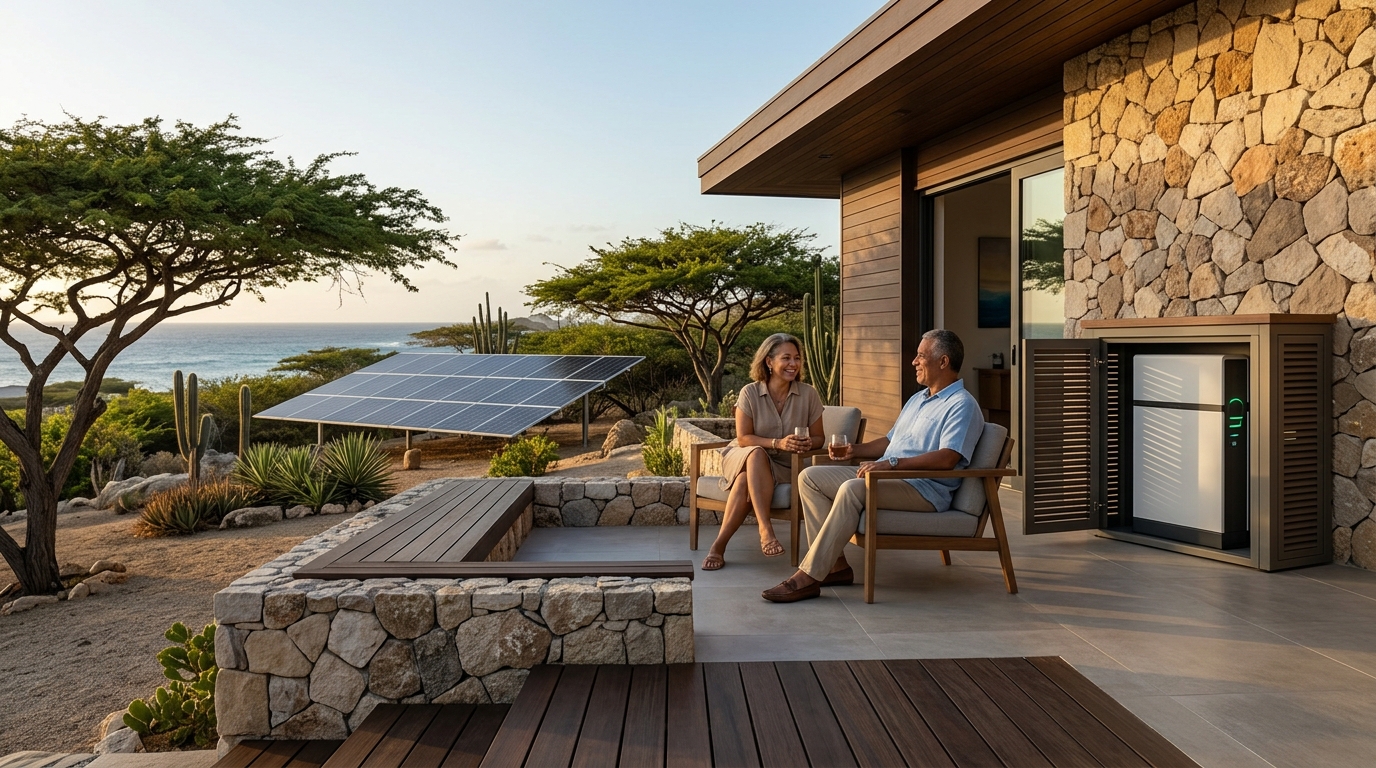
Going off-grid requires balancing energy storage, generation, and load management to ensure reliability. Bello Electrical Services helps Aruba businesses and residents design compliant, resilient systems. This guide covers backup power sources and days of autonomy, the two critical pillars of a successful off-grid transition.
Backup Power Source
Choosing the right backup power source is the first major decision in any off-grid project. A backup power source is a secondary energy system that activates when the primary generation source fails or is insufficient. In Aruba, where solar irradiance is high but weather events can disrupt supply, redundancy is essential. Bello Electrical Services designs systems that integrate multiple power sources to ensure continuous operation. For additional details, review the .
Solar and Battery Storage
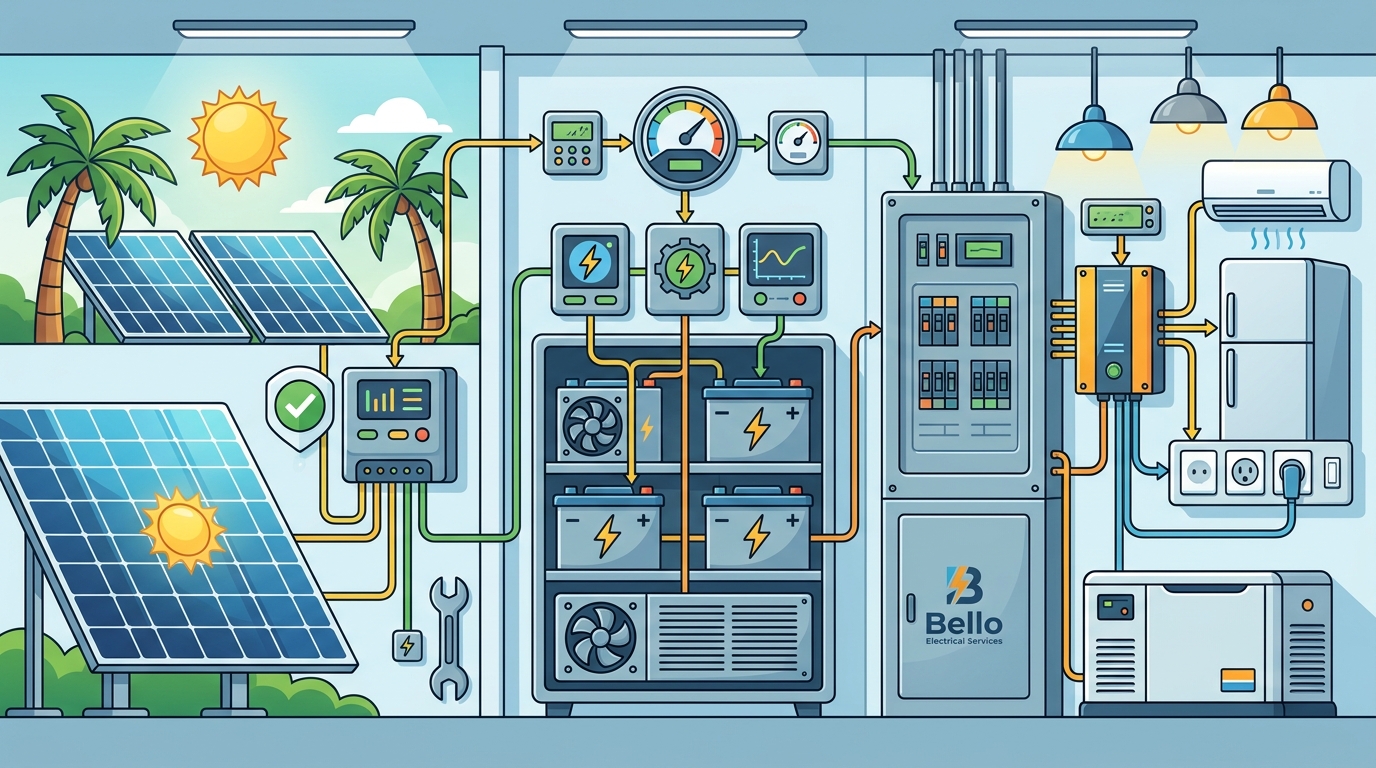
Solar photovoltaic panels paired with lithium-ion battery banks form the backbone of most modern off-grid systems. Solar energy is abundant in Aruba, making it an ideal primary source. However, solar generation stops at night and during heavy cloud cover. Battery storage bridges this gap by storing excess daytime energy for use during low-generation periods. The size of the battery bank must match the expected load and the desired autonomy period. For additional details, review the Customer Experience.
Generator Integration
Generators provide a reliable backup when solar and battery resources are depleted. A generator is a mechanical device that converts fuel into electrical energy. In off-grid scenarios, generators are typically used as a last resort to recharge batteries or power high-load equipment. Bello Electrical Services ensures that generator integration is seamless, with automatic transfer switches that minimize downtime. This hybrid approach balances cost, reliability, and environmental impact. For additional details, review the Frequently Asked Questions.
Grid-Tied with Backup
Days of Autonomy
Days of autonomy is the number of days a system can operate without external energy input. This metric is critical for sizing battery storage and ensuring reliability. In Aruba, weather patterns and seasonal load variations influence the required autonomy. Bello Electrical Services calculates days of autonomy based on specific load profiles and generation forecasts. For additional details, review the About.
Calculating Autonomy
To determine days of autonomy, you must first calculate the daily energy consumption in kilowatt-hours (kWh). This involves summing the power draw of all connected devices and multiplying by their operating hours. Next, you estimate the daily energy generation from solar panels, accounting for weather and panel efficiency. The ratio of stored energy to daily consumption gives the number of days of autonomy. For example, a 10 kWh battery bank powering a 5 kWh daily load provides two days of autonomy.
Impact of Weather and Seasonality
Weather conditions significantly affect solar generation and, consequently, days of autonomy. In Aruba, the dry season offers higher solar irradiance, while the wet season may reduce generation. Seasonal load variations, such as increased air conditioning use in summer, also impact autonomy. Bello Electrical Services uses historical weather data and load profiles to design systems that maintain adequate autonomy throughout the year.
Resilience and Redundancy
Higher days of autonomy provide greater resilience against prolonged low-generation periods. However, increasing autonomy also increases system cost and complexity. A balance must be struck between reliability and budget. Bello Electrical Services recommends a minimum of three to five days of autonomy for critical loads, with additional redundancy for non-critical loads. This approach ensures that essential services remain available during extended weather events or equipment failures.
Key Takeaways
- Backup power sources, such as generators and battery storage, are essential for off-grid reliability.
- Days of autonomy is a critical metric for sizing battery storage and ensuring system resilience.
- Solar and battery systems form the core of most off-grid installations in Aruba.
- Generators provide a reliable backup but should be used sparingly to minimize fuel costs and emissions.
- Weather and seasonality significantly impact solar generation and required autonomy.
- Bello Electrical Services designs NEN 1010-compliant systems tailored to specific load profiles.
- Proper system design balances cost, reliability, and environmental impact.
Frequently Asked Questions
What is the best backup power source for an off-grid system?
The best backup power source depends on your specific needs, budget, and location. Solar and battery storage are ideal for primary generation, while generators provide reliable backup during prolonged low-generation periods. Bello Electrical Services recommends a hybrid approach that combines both for maximum resilience.
How many days of autonomy should I plan for?
The required days of autonomy depends on your load profile and local weather patterns. For critical loads in Aruba, Bello Electrical Services recommends a minimum of three to five days of autonomy. This ensures that essential services remain available during extended weather events or equipment failures.
Can I use a generator as my primary power source?
Generators are not ideal as primary power sources due to high fuel costs, noise, and emissions. They are best used as backup power to recharge batteries or power high-load equipment during low-generation periods. Bello Electrical Services designs systems that minimize generator usage while ensuring reliability.
How does weather affect days of autonomy?
Weather conditions, such as cloud cover and rain, reduce solar generation and, consequently, days of autonomy. In Aruba, the wet season may require higher autonomy to compensate for lower solar irradiance. Bello Electrical Services uses historical weather data to design systems that maintain adequate autonomy throughout the year.
Is it worth staying grid-tied with backup?
Grid-tied systems with backup capabilities offer a practical middle ground for businesses that cannot afford full off-grid autonomy. They provide resilience during outages while benefiting from lower generation costs. Bello Electrical Services designs hybrid systems that comply with local electrical codes and ensure seamless switching between grid and local generation.
How do I calculate my daily energy consumption?
To calculate daily energy consumption, sum the power draw of all connected devices in watts and multiply by their operating hours in days. Convert the result to kilowatt-hours (kWh) by dividing by 1,000. This figure is essential for sizing battery storage and determining days of autonomy. Bello Electrical Services performs detailed load analyses to ensure accurate system design. Learn more: Commercial Electrician Aruba Bello.